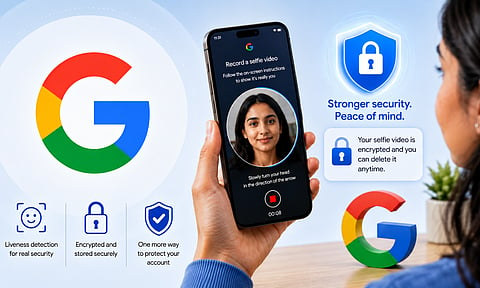


Hyderabad: Google has introduced a selfie video feature that allows eligible users to verify their identity during account recovery.
The feature is being rolled out to eligible personal Google Accounts and provides an additional way for users to regain access to their accounts if they cannot use their usual recovery methods.
Selfie for online security
The rollout comes amid Google’s broader efforts to strengthen online security.
In recent months, the company has expanded AI-powered scam detection features across its products. It has filed a lawsuit against the operators of the ‘Outsider’ phishing kit, which it alleges used its Gemini AI to generate phishing websites and scam text messages.
How does it work?
Users who choose to set up the feature are asked to record a selfie video by following on-screen instructions. The video is encrypted and stored in the user’s account for future identity verification during account recovery.
If a user needs to recover their account, Google may ask them to record another selfie video. The company compares the new recording with the previously stored selfie video to verify the user’s identity before allowing access.
How does it distinguish a real face from a photograph?
According to the announcement, the feature uses liveness detection and guided head movements to help distinguish a real person from attempts to use a photograph, a pre-recorded video or other forms of spoofing.
Users must first set up a selfie video before they can use it during account recovery. The company describes selfie video as an alternative recovery factor that can be used instead of traditional recovery methods such as a recovery phone number or recovery email.
Selfie video is currently available only for eligible personal Google Accounts.
It is not available for Google Workspace accounts, supervised accounts or users enrolled in Google’s Advanced Protection Program.
What happens to the selfie video?
The reference selfie video is encrypted and users can delete it from their account at any time.
Users can choose whether to allow their selfie video to be used to improve Google’s facial recognition, age estimation and other verification technologies. This setting is optional and can be changed at any time.
Users who do not opt in will still be able to use selfie video for account recovery. Those who choose to opt in allow Google to use their selfie video to improve its verification technologies.
The feature is not yet available for all regions, accounts or devices, and users can check whether they are eligible to set it up.
The company recommends setting up multiple sign-in methods and describes selfie video as an alternative to traditional recovery factors such as a recovery email or phone.
Users who choose not to enable selfie video can continue using other supported sign-in and recovery methods, including passwords, passkeys and security keys.
Company addresses privacy concerns
The feature requires users to store a reference selfie video, which is a form of biometric data.
While Google says the video is encrypted and users can delete it at any time, some users may still have concerns about storing facial data with an online service.
Users can decide whether to allow their selfie video to be used to improve the company’s facial recognition, age estimation and other verification technologies. Those who do not opt in can still use selfie video for account recovery.
The company states selfie video is encrypted and is available as an optional recovery feature rather than a mandatory sign-in requirement.
Whether users choose to enable it may depend on how they balance the convenience of an additional recovery option with their personal privacy preferences.

