
Hyderabad: Children in climate-stressed districts face 1.25 times higher risk of being underweight, 1.15 times greater chance of stunting and mothers deliver babies outside hospitals 1.38 times more often than in safer zones.
These findings were made in a study titled ‘Health SDGs are at risk from climate change: Evidence from India’ tracking 1,54,547 children and 4,47,348 women across 575 districts.
It reveals that climate vulnerability now determines whether children grow properly and where mothers give birth, independent of poverty, education or healthcare access.
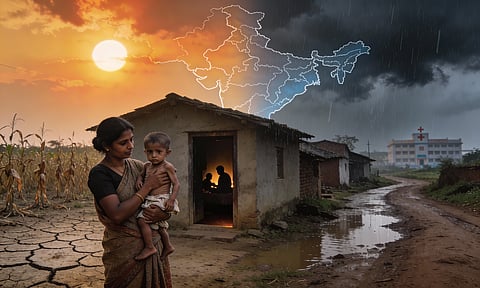
This scene plays out across hundreds of districts in India. Climate change has begun to reshape the country’s health outcomes in ways researchers can now measure and map.
The study, published in PLOS, reveals that children who grow up in districts facing droughts, floods and heatwaves carry a burden their bodies show. The research, conducted by the Institute of Economic Growth in New Delhi, examined 575 districts and found patterns that link the weather to the weight of children and the choices mothers make about where to give birth.
High percentage of children vulnerable to climate’s impact
As much as 80 per cent of India’s population now lives in districts classified as moderately to highly vulnerable to climate events. The researchers used data from the National Family Health Survey. They compared this information with climate vulnerability assessments from the Central Research Institute for Dryland Agriculture.
The numbers tell a story that moves beyond poverty and education.
Children bear the brunt
In districts marked as highly vulnerable to climate change, children face odds that stack against them before they learn to walk.
These children show a 1.25 times higher chance of being underweight compared to children in districts where climate stress remains lower. The risk of stunting rises by 1.15 times. Wasting affects them 1.06 times more often.
The researchers controlled for factors that usually explain malnutrition: household income, sanitation access, birth order, parental education and food availability. Climate vulnerability emerged as a force that acts independently.
Rajasthan, Madhya Pradesh, Chhattisgarh, Odisha, Jharkhand, Uttar Pradesh and parts of the Northeast fall into the high or very high vulnerability categories. These regions record the worst health indicators. The pattern holds across the data.
Consider what happens when crops fail. Families eat less diverse food. Children consume fewer calories. Heat drains energy from pregnant women and infants. Water becomes scarce, raising infection risks.
The mechanisms connect climate events to the bodies of children in ways that persist even when families receive education and healthcare.
National data already shows that 36 per cent of children in India experience stunting. Thirty-two per cent register as underweight. Nineteen per cent show wasting. The study suggests these figures will climb unless policies shift to account for climate stress.
Mothers deliver outside hospitals
Women in highly vulnerable districts face a different calculus when labour begins.
The study found these women experience a 1.38 times higher likelihood of delivering babies outside health facilities.
Distance creates one barrier. Transport availability creates another. During floods, roads disappear. Heatwaves make travel dangerous. Cyclones shut down services. Nearly half the women surveyed in high-vulnerability rural districts reported difficulties in reaching medical help when they needed it.
The study authors note that financial constraints and absent healthcare providers compound the problem. When climate events strike, they disrupt systems that already function at the margins.
A woman in a vulnerable district might plan to reach a hospital. Then the rains come. The bridge floods. The primary health centre closes because staff cannot travel. She delivers at home. The risk rises for complications that could have been prevented.
The data shows this pattern repeats across regions. Climate vulnerability predicts where women will give birth and what risks they will face, independent of their education level or economic status.
South India holds a better position
Tamil Nadu, Karnataka, Kerala, Telangana and Andhra Pradesh fall into the moderately vulnerable category. These states perform better on health indicators compared to northern and eastern regions.
But moderate vulnerability still means risk. Kerala experiences recurrent floods and landslides. Tamil Nadu and Andhra Pradesh face heatwaves, water scarcity and cyclones. Telangana sees urban heat islands expand as cities grow.
These disruptions affect agricultural output. They compromise household food security. They interrupt healthcare access. The factors that determine child growth and maternal well-being respond to these pressures.
Public health infrastructure in South India appears to cushion some impacts. The region’s health systems function more reliably. But researchers warn that this advantage cannot hold indefinitely against mounting climate stress.
Climate joins the list of health determinants
The study makes a case that shifts how researchers and policymakers view health outcomes. Climate vulnerability acts as a core determinant, not merely an environmental concern that affects health indirectly.
“Traditional factors like poverty and education matter, but climate stress now exerts an independent influence on health outcomes. It is a serious development challenge,” the authors stated.
Research methodology
The research team used multivariate logistic regression to examine relationships between variables. They tested for multicollinearity and found values below 2, indicating the variables measured distinct phenomena. They applied sampling weights from the survey to ensure the analysis reflected population patterns.
The log-odds coefficients reveal the strength of associations. For stunting, the coefficient reaches 0.14. For wasting, it stands at 0.06. For underweight children, it rises to 0.22. For non-institutional deliveries, it peaks at 0.32.
These numbers quantify how climate vulnerability increases the probability of adverse health outcomes. The variation across outcomes shows that climate stress does not affect all health measures equally. Non-institutional deliveries show the largest impact, followed by children being underweight and stunted.
The mechanisms that connect climate to health
The study identifies pathways through which climate change degrades health outcomes.
Droughts and floods reduce agricultural yields. Families lose income and food diversity. Children consume fewer nutrients. Heat stress affects pregnant women and infants, increasing risks of dehydration, infections and preterm birth. Cyclones and heavy rains disrupt healthcare delivery, particularly in rural areas. Water scarcity limits sanitation and hygiene. Migration and displacement create new vulnerabilities for women and children.
These mechanisms operate simultaneously. A district facing drought sees crop failures. Families migrate. Health services become harder to access. Children fall ill more often. The effects compound.
“In highly vulnerable districts, adverse health outcomes are seen to be proportionately higher in occurrence than in the other districts,” the study reads. The data maps these proportions. Districts categorised as highly vulnerable consistently show higher rates of adverse outcomes compared to other districts.
What do the findings demand
India pursues targets under SDG 2 on Zero Hunger, SDG 3 on Good Health and Well-being, and SDG 13 on Climate Action. Progress has occurred. However, gaps persist, especially in nutrition and maternal care.
Climate change threatens to reverse gains unless health systems adapt.
The authors recommend integrating climate vulnerability assessments into all levels of health planning. This includes the National Health Mission, District Health Action Plans, State Climate Action Plans and nutrition programmes like POSHAN Abhiyan.
Specific actions include strengthening climate-resilient health infrastructure, building early-warning systems for heatwaves and floods, ensuring uninterrupted medicine supply chains, improving rural transport and emergency services, and coordinating across health, agriculture and disaster management departments.
“The study provides quantitative evidence to establish the existence of a significant climate impact and its potential to disrupt sustainable SDG achievements,” the authors said. “As such, it establishes the unequivocal need for adaptation and for building a climate resilient healthcare system at sub-national levels to ensure that the benefits of investments made in achieving good health and wellbeing can be fully realised.”

