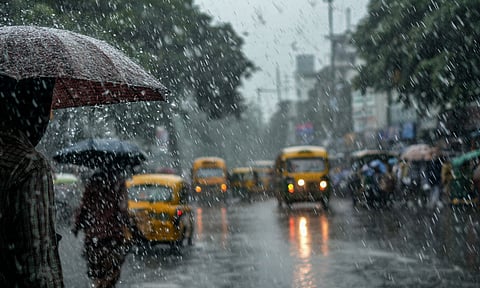

Hyderabad: The monsoon used to arrive like a promise. Farmers in the four dryland districts of Telangana—Mahabubnagar, Wanaparthy, Gadwal and Nagarkurnool—grew up watching the sky in June, reading clouds the way their fathers read them, trusting a rhythm that had held for generations. They sowed. They waited. The rains came.
However, the optimism has dried out.
Nearly 7 in 10 farmers in Telangana’s dryland districts say water is disappearing. Not might disappear. Already disappearing. And groundwater, once gone, does not come back quickly. That is a slow emergency, and a new study says most farmers now feel it in their bones.
That rhythm has broken.
What did the ICRISAT study reveal?
A study published in the Journal of Scientific Research and Reports, conducted by Hyderabad-based ICRISAT and the University of Agricultural Sciences, Raichur, Karnataka, surveyed 240 farmers across these four districts of Telangana during 2023–24. The researchers asked them to respond to 24 statements about climate change, about water, weather, crops, pests and livelihoods. What came back was not panic. It was something quieter, and in many ways more unsettling: recognition.
“Farmers widely perceive increasing drought frequency, erratic rainfall, rising temperatures, pest and weed infestation and declining groundwater availability as major climate-related challenges,” the authors said.
The water that went missing
Start with water, because that is where the farmers started.
As much as 70.8 per cent of respondents, i.e., nearly 170 of the 240 farmers surveyed, said that declining water resources connect directly to climate change.
Not seven in 100 but seven in 10. In a region that already sits at the edge of semi-aridity, where borewells reach deeper every season and where the river does not always run when it should, this number does not surprise the people who live there. It confirms what their buckets already told them.
The weather stopped following the calendar
As per the study, 62.5 per cent of farmers said extreme weather events, droughts and floods have grown more frequent. They did not read this in a report. They watched it on their own land.
As much as 58 per cent said they can no longer decide with confidence when to sow and when to harvest. The monsoon arrives late. It leaves early. When it does arrive, it dumps rain unevenly across fields. Over 56 per cent reported hailstorms striking more regularly during the rabi season, the winter crop many families depend on to recover what kharif failed to deliver.
“Uncertainty in rainfall patterns adversely affects crop production,” the study notes, adding that 54.2 per cent of farmers agreed with this directly.
As much as 58 per cent also said climate change now directly affects farm profitability. The math is simple: unpredictable weather means unpredictable yields, which means unpredictable income.
The fields look unfamiliar
As much as 60.5 per cent of farmers reported higher incidences of pests and invasive weed species compared to previous years. New weeds have appeared in fields that these families worked for decades. Fields they knew corner to corner. Now something unfamiliar grows there, something the old knowledge does not cover.
About 60.4 per cent said livestock rearing has grown more vulnerable to climate variability. For families where cattle represent both income and emergency backup, that vulnerability has a direct cost.
“The majority of respondents observed higher incidences of invasive weed species and pests, which linked altered climatic conditions to increased pest and weed proliferation,” the authors write.
Cities becoming home
As much as 54.1 per cent of farmers said climate-induced factors are driving farmers to migrate toward cities.
This migration does not announce itself. A family drills one more borewell, watches it run dry, and then boards a bus to Hyderabad. No press conference. No data point at the time of departure. Just a locked door.
“Climate-induced factors are driving increased migration of farmers to urban areas,” the study records. As much as 60.5 per cent said changing climate patterns have disrupted traditional livelihood strategies altogether.
The experience paradox
Here is the finding that cuts sharpest: The researchers found that education, scientific orientation, training, media access and decision-making ability all connect positively to higher climate awareness. But age and farming experience showed a negative relationship with perception levels.
Which means, the farmer who has worked the same land for 40 years understands climate change less clearly than a younger, formally educated farmer. Experience, the thing that kept families alive across generations, now filters out new patterns rather than catching them.
Only 33.33 per cent of the 240 farmers surveyed showed a high level of climate perception, 41.66 per cent showed moderate awareness, and 25 per cent, one in every four farmers, fell into the low perception category.
“This distribution underscores variability in farmers’ awareness and concern levels, potentially influenced by education, exposure to information and personal experiences with climate impacts,” the study says.
What researchers say must change
The authors call for strengthened climate-focused agricultural extension services, location-specific advisories calibrated to local soil and groundwater conditions, and expanded training programmes.
“Strengthening extension networks, promoting climate-focused training and ensuring timely access to climate advisories are crucial to enhance adaptive capacity and build resilience among dryland farmers,” the authors conclude.
The infrastructure for this exists in India, at least in parts. The question the study leaves open is whether it moves fast enough, for the wells already dropping, for the rabi crops hailstorms already hit, and for the families already on those buses.

