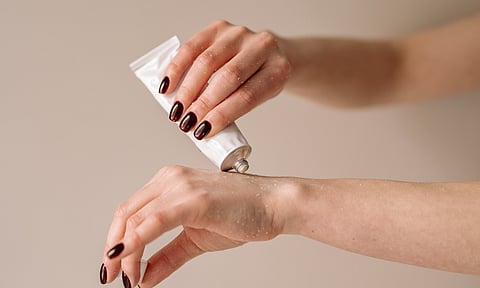

Hyderabad: Dr Rajetha Damisetty holds up a small blue and white box to the camera. It is called AkniRed 3D. The packaging shows a woman’s clear, blemish-free face. The brand name promises something cosmetic, something aspirational. The price on Meesho, where she bought it, is low enough that the platform would not even sell her a single unit. She had to buy four.
“Who doesn’t want to have clear skin?” she says.
Then she reads out what is actually inside the tube—Betamethasone, a mid-potent steroid; Clindamycin, an antibiotic she notes is supposed to be saving lives in the ICU; and nicotinamide.
Three active pharmaceutical ingredients in one cream, requiring a prescription by law, are sold freely online to anyone searching for an acne solution. The box even carries a red label stating it must be dispensed only against a valid prescription from a registered medical practitioner.
Dr Damisetty, a dermatologist and president-elect of the Indian Association of Dermatologists, Venereologists and Leprologists (IADVL) Telangana, is not surprised. The roots of the problem have a scientific name.
The fungus that now bears India’s name
Around 2015, dermatologists across India began noticing something unusual. Patients with common ringworm were no longer responding to standard antifungal treatment. Rashes spread across the groin, trunk, buttocks and face.
Infections that should have cleared in weeks persisted for months, even years.
Researchers traced the problem to a genetic variant within the Trichophyton mentagrophytes fungal complex. By 2020, a Japanese research group formally named the fungal variant a separate species based on isolates from patients in India and Nepal.
They called it Trichophyton indotineae. The prefix ‘indo’ references India. The suffix ‘tineae’ comes from the Latin for fungal skin infections. Put together, the name effectively means the India-associated fungus that causes ‘tinea’ infections.
“Because of that, antimicrobial resistance and antifungal resistance have increased so much that it has led to the emergence, the birth of a new organism. That new organism is being named after our country,” said Dr Damisetty.
What is the significance of the fungus variant?
The fungus is not an ordinary skin infection gone slightly wrong. It is clinically distinct, genetically unique and stubborn in ways that exhaust standard treatment protocols. It causes chronic, recurrent and extensive infections, often spreading rapidly to multiple family members through shared towels, bedding and close contact.
It involves the genitals in some cases and produces a severe, unrelenting itch.
Most critically, it carries a near-built-in resistance to terbinafine, the most widely used first-line antifungal drug, through mutations in a gene called squalene epoxidase.
In one multicentre study, up to 76 per cent of T. indotineae samples collected in India showed resistance to terbinafine in laboratory testing. Researchers have also begun documenting strains resistant to azole antifungals, further narrowing treatment options.
“Standard treatments, particularly topical antifungal medications, are often ineffective against T. indotineae infections,” said Dr Kaushik Kumar, a Hyderabad-based dermatologist. “While systemic antifungal therapies like itraconazole have shown some success, they typically require longer treatment durations, often exceeding six weeks, and higher doses compared to treatments for other similar fungal infections.”
Itraconazole remains the most effective available oral treatment, but courses lasting up to 12 weeks may be required in some patients. Double mutant strains, resistant to both terbinafine and azoles, have also been recorded, leaving clinicians with very few reliable options.
How a cheap cream created the conditions for resistance
The fungus did not emerge from nowhere.
Dermatologists trace its rise directly to a practice that has become routine across India: the widespread, unsupervised use of fixed-dose combination creams sold cheaply at pharmacies and, increasingly, on e-commerce platforms.
These creams carry three or more medicines in a single tube. A potent topical steroid forms the core, alongside an antifungal and an antibiotic. They act quickly, suppress symptoms within days and cost very little.
For patients, they feel like a solution.
For the fungus, they create the perfect conditions to evolve.
“The combination of a topical steroid with an antimicrobial creates an environment where the microorganisms are exposed to a low concentration of the drug, which is not enough to eliminate them but can lead to adaptations that cause drug resistance,” explained Dr Kumar. “The infection does not reduce completely. The microorganisms emerge stronger and the patient’s problem gradually worsens.”
The steroid component is the key mechanism. Human skin has its own immune defenses. When a fungus begins to colonise the surface, the body reacts. Blood vessels dilate, immune cells gather and inflammatory signals activate. The redness and itching are signs that the body is fighting. The steroid shuts all of that down.
With the immune response suppressed, the fungus encounters a more favourable environment. It spreads deeper into skin layers, into areas topical medication cannot easily reach. The antifungal in the same tube attempts to kill it, but may only stress it without eliminating it. That is precisely the condition under which microbes develop resistance.
Dr C Karishni, a dermatologist resident at Gandhi Medical College, describes the clinical fallout plainly: “The fungus actually travels deeper into the dermis. It requires two to three months of antifungal therapy to clear. When treatment is stopped early, the infection returns and often spreads further.”
Patients rarely realise any of this. The itching stops within days of applying the cream. They assume the infection has cleared and discontinue treatment. When symptoms return, they buy another tube.
A name that 42 countries know, but Indian researchers want to change
The fungus has not stayed in India. It has been documented in Germany, France, Belgium, Switzerland, Australia, Canada, Iran, the UAE and the United States, among others. Germany has reported some of the highest case numbers among patients with no travel history to India at all. The infection has been confirmed in 42 countries.
This global spread has sharpened a long-standing discomfort among dermatologists about the name itself.
A group of researchers from India, joined by colleagues from 13 other countries, published a formal proposal in the Indian Journal of Dermatology, Venereology and Leprology calling for the name to be changed.
Their argument rests on disputed origins. The fungus was identified retrospectively in genetic databases from Australia in 2008, Oman in 2010 and Iran in 2016, well before it caused the epidemic in India. Its true geographic origin remains unknown.
“The region-specific nomenclature prejudicially impacts the perceptions of clinicians and public alike, ignoring the exhortations of the World Health Organisation, the American Society of Microbiology and others,” the authors stated.
The WHO made a similar argument in 2022 when it renamed Monkeypox to Mpox, citing concerns about stigma and the misleading implications of geographically anchored disease names.
Proposals now include reverting to a neutral scientific designation such as T. mentagrophytes genotype VIII, the name the fungus carried before the 2020 reclassification and one that references no country or region.
Regulations that exist on paper
India’s drug regulator, the DCGI, has not been entirely inactive, but has it been effective?
A gazette notification in March 2016 banned the manufacture of 349 irrational fixed-dose combinations under the Drugs and Cosmetics Act. Further combinations, including topical antifungals paired with anti-bacterials and steroids, were added to the banned list in 2024.
Yet dermatologists say the creams continue to circulate widely.
Dr Damisetty’s Meesho purchase is a case in point. AkniRed 3D, a Schedule H product requiring a valid prescription, was available in a bundle offer with no verification required. She had to purchase four units because that was the only offer available.
“Not even our neighbours, Bangladesh, Nepal or Sri Lanka have such bad drug regulations,” she said. “It is time we people unite and fight for better drug regulations.”
The dangerous Rs 20 cream for our neighbours
Dr Sudip Parajuli, a dermatologist from Kathmandu, Nepal, in a conference in India, pointed to the cross-border implications directly. “Because the price is low here, these creams are easily available in Nepal. India is pushing these drugs into neighbouring markets,” he said.
Concerns extend beyond labelled pharmaceutical products. Doctors flagged the growing sale of imported creams arriving in Korean, Japanese or Chinese packaging, marketed as beauty or fairness products, that, on analysis, contain potent steroid formulations.
“Many come in fancy boxes and sell for just 20 rupees,” said Dr Parajuli. “They’re marketed as beauty creams but are essentially potent steroid formulations.”
How bad is the problem?
Dr Sudha Rani, Head of the Department of Dermatology at Gandhi Medical College in Hyderabad, put a number to the scale of the problem inside clinics.
Nearly 80 per cent of dermatological cases she now sees involve steroid-modified conditions. The consequences extend beyond fungal infections. Prolonged misuse causes atrophy, stretch marks, steroid-induced acne and in severe cases, systemic effects including glaucoma and hormonal disturbances.
Researchers have called for stricter enforcement of prescription-only regulations, improved diagnostics, and an international committee to oversee the naming of new pathogens, so that a country’s name is never again made to carry the burden of a systemic regulatory failure.
Until those changes arrive, the tube remains on the shelf: A blue and white box, a woman’s clear face on the packaging, an antibiotic that belongs in an ICU. Four for the price of one. No prescription required.

