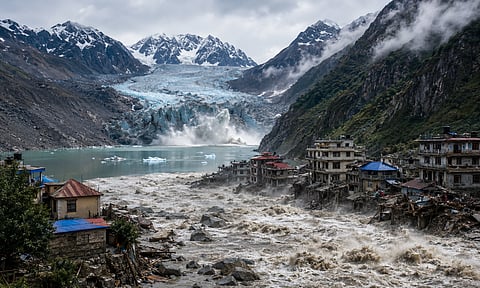


Hyderabad: The flash floods along the Nepal-China border have drawn attention to a larger question: how vulnerable are the Hindu Kush Himalayas as temperatures rise and extreme weather becomes more difficult to manage?
What is UN saying?
UN Climate Chief Simon Stiell has pointed to the disaster as a warning about the growing vulnerability of the region’s mountain ecosystems.
His statement comes as scientists and climate assessments have documented rapid changes in glaciers, snow cover and other components of the Himalayan cryosphere.
A chain of hazards
Mountain disasters do not always begin with rainfall.
In the high Himalayas, warming can alter glaciers, ice and frozen ground. These changes can destabilise slopes or contribute to the formation and growth of glacial lakes. A sudden collapse of ice, rock or a natural dam can then release enormous quantities of water and debris downstream.
The result can be a cascade of hazards, a landslide triggering a river blockage, followed by a sudden flood, with communities downstream facing the consequences.
The Hindu Kush Himalaya Assessment by the International Centre for Integrated Mountain Development (ICIMOD) has documented widespread glacier retreat and changes in glacial lakes across the region.
These changes can increase exposure to glacial lake outburst floods and other mountain hazards.
Why warming makes a difference
The climate signal is not as simple as saying that every flood is caused by climate change.
A particular landslide, glacier collapse or flood has multiple possible triggers and scientists need event-specific evidence before attributing it directly to global warming.
How climate change makes a mark
What climate change can do is alter the background conditions.
Higher temperatures accelerate glacier and snow loss and can affect the stability of frozen ground. At the same time, climate change is expected to influence the intensity of heavy precipitation in many parts of Asia.
The IPCC has identified increasing risks from glacier and snow changes, landslides and other cryosphere-related hazards in the Hindu Kush Himalayas as the region warms.
The risk travels downstream
The vulnerability is not confined to the high mountains.
The Hindu Kush Himalayas feed some of Asia’s major river systems and support hundreds of millions of people downstream. Valleys that were once relatively remote now contain highways, bridges, hydropower facilities, settlements and tourism infrastructure.
When a mountain hazard occurs, it can therefore damage several parts of this network at once.
A destroyed bridge can cut off a community. A damaged road can delay rescue operations. A disrupted hydropower project can affect electricity supplies.
This makes infrastructure planning as important as disaster response.
Why early warning is difficult
Early-warning systems can detect many rainfall-driven floods, but sudden mountain events are more challenging.
Remote terrain makes it difficult to maintain monitoring equipment, while a glacier collapse or landslide can happen faster than authorities can issue and act on a warning.
Researchers and regional organisations have increasingly stressed the importance of combining satellite observations, ground sensors, glacier and lake monitoring, weather forecasts and river-level data.
Cross-border cooperation is equally important because mountain hazards do not stop at national boundaries.

