
Hyderabad: On the night of March 13, 2025, keepers at the Vedanthangal aviary inside Chennai’s Guindy Children’s Park walked in to find 30 birds dead on the ground: 24 herons and six pelicans.
By morning, the count kept rising: two more the next day, two pelicans and a painted stork the day after, and then more on March 18.
The deaths happened in the dark, without warning, without sound.
Staff collected samples and dispatched them first to the Advanced Institute of Wildlife Conservation, then to the National Institute of High Security Animal Diseases (NIHSAD) in Bhopal. On March 19, NIHSAD confirmed what many had feared: H5N1, an avian influenza.
Wildlife Warden Yogesh Kulal signed the closure order the same day. “This closure is a precautionary measure to facilitate intensive sanitisation,” he wrote in the circular to the public.
Over 20 more birds, including herons, storks and ibises, died even on the morning the park shut its gates. Staff pulled on masks and gloves. Foot baths filled with potassium-based disinfectant went up at every entry point. The 150-odd birds, across the remaining approximately 10 species, now live under round-the-clock watch.
What is avian influenza?
According to the World Health Organisation (WHO), avian influenza is a family of viruses that circulates primarily in birds. Wild birds, particularly waterfowl and shorebirds, carry these viruses in their intestines and shed them through droppings, saliva and nasal secretions.
Most of the time, the birds show no symptoms at all. Then they land near a poultry farm, near a wetland aviary, near a park where pelicans wade and the virus is transmitted.
24,000 chickens died in a week in AP
H5N1 is classified as highly pathogenic avian influenza (HPAI). In dense poultry populations, it kills at a rate that devastates entire flocks within days.
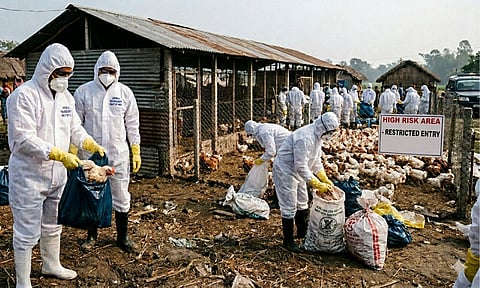
In Annamayya district of Andhra Pradesh in February this year, over 24,000 chickens died within a week after H5N1 was confirmed in Sodam mandal. Culling teams moved through the villages of Ammagaripalli and Puttavaripalli in hazmat gear, removing birds by the thousands.
How does the virus spread?
The virus travels in the faeces of infected birds. It survives on surfaces, in water and soil. A bird can carry it and appear healthy, then collapse and die within hours.
“Avian influenza often spreads through the faeces of infected birds. Sometimes birds may not show symptoms; they may suddenly die. That is why continuous monitoring is crucial,” Telangana Veterinary and Animal Husbandry Director Dr B Gopi said.
But how safe are humans?
The moment the biological line was crossed
On February 28, 2025, a family in Narasaraopet, a town in Andhra Pradesh’s Palnadu district, sat together preparing chicken at home. Their two-year-old daughter asked for a piece. They gave her one, raw.
“When the child asked for a piece of chicken while we were cutting it, we gave it to her to eat. She fell ill afterwards. We have done this before, but none of us has had any health problems after eating cooked meat,” the family told local media.
Within two days, she developed fever, breathlessness, nasal discharge, seizures and diarrhoea.
Her family rushed her to AIIMS Mangalagiri on March 4. Doctors treated her for 12 days. She died on March 16. Her swab, confirmed by the National Institute of Virology in Pune, tested positive for H5N1.
India’s health authorities recorded it as the country’s second human death from bird flu.
The Animal Husbandry Department stated that no bird flu outbreaks had been reported in Palnadu district at the time. That gap, between where the virus appears in poultry surveillance and where it turns up in a child, is precisely what scientists find troubling.
More cases surface
India’s first recorded human death from H5N1 came in July 2021, when an 11-year-old boy from Haryana, undergoing immunosuppressive treatment for a pre-existing illness, died at AIIMS Delhi. His family ran a butchery. The source of his infection was never established.
In early 2024, a four-year-old in Kolkata contracted H9N2 after contact with poultry at home and recovered. Later that year, a child who travelled from Kolkata to Australia tested positive for H5N1, prompting WHO to flag India as a likely source.
The virus is moving beyond birds
What changed the conversation at the government level was not just the human cases. It was the species list.
By April 2025, H5N1 had been confirmed in tigers, leopards, vultures, hawks, egrets and crows in Maharashtra. A pet cat in Madhya Pradesh tested positive. Jungle cats in Goa and demoiselle cranes in Rajasthan carried the same infection. Eight states reported poultry outbreaks, with 34 epicentres identified across Jharkhand, Telangana, Chhattisgarh and other states.
Andhra Pradesh Animal Husbandry Director T Damodar Naidu put the mutation risk in plain terms. “Bird flu is not a direct threat to humans unless there is close contact with infected poultry, but vigilance is crucial,” he said, adding that human-to-human transmission is not happening currently, but viruses evolve.
Do not eat raw or undercooked animal products
“Human infections remain rare, and effective preventive measures exist. Avoid direct contact with infected birds or animals. Do not consume raw or undercooked animal products,” he said.
Scientists track H5N1 across Asia with particular attention because the region concentrates the conditions the virus needs: dense poultry farming, migratory bird flyways, live animal markets and millions of households where people and birds share the same ground.
Each human case that emerges from this geography generates genome sequences, and those sequences tell researchers whether the virus is drifting toward a form that moves more easily between people.

